
When a pipeline leaks, a repair clamp is often the fastest and most cost-effective solution — no pipe cutting, no shutdown, no welding. But while buyers usually compare clamp band width, bolt grade, or coating, one detail is frequently overlooked: the inner rubber liner.
The liner is the part that actually touches the pipe surface and stops the leak. Its structure determines whether the repair holds for years — or starts weeping again within months. In the market, there are two common liner designs: the V-shaped special liner and the normal flat liner.
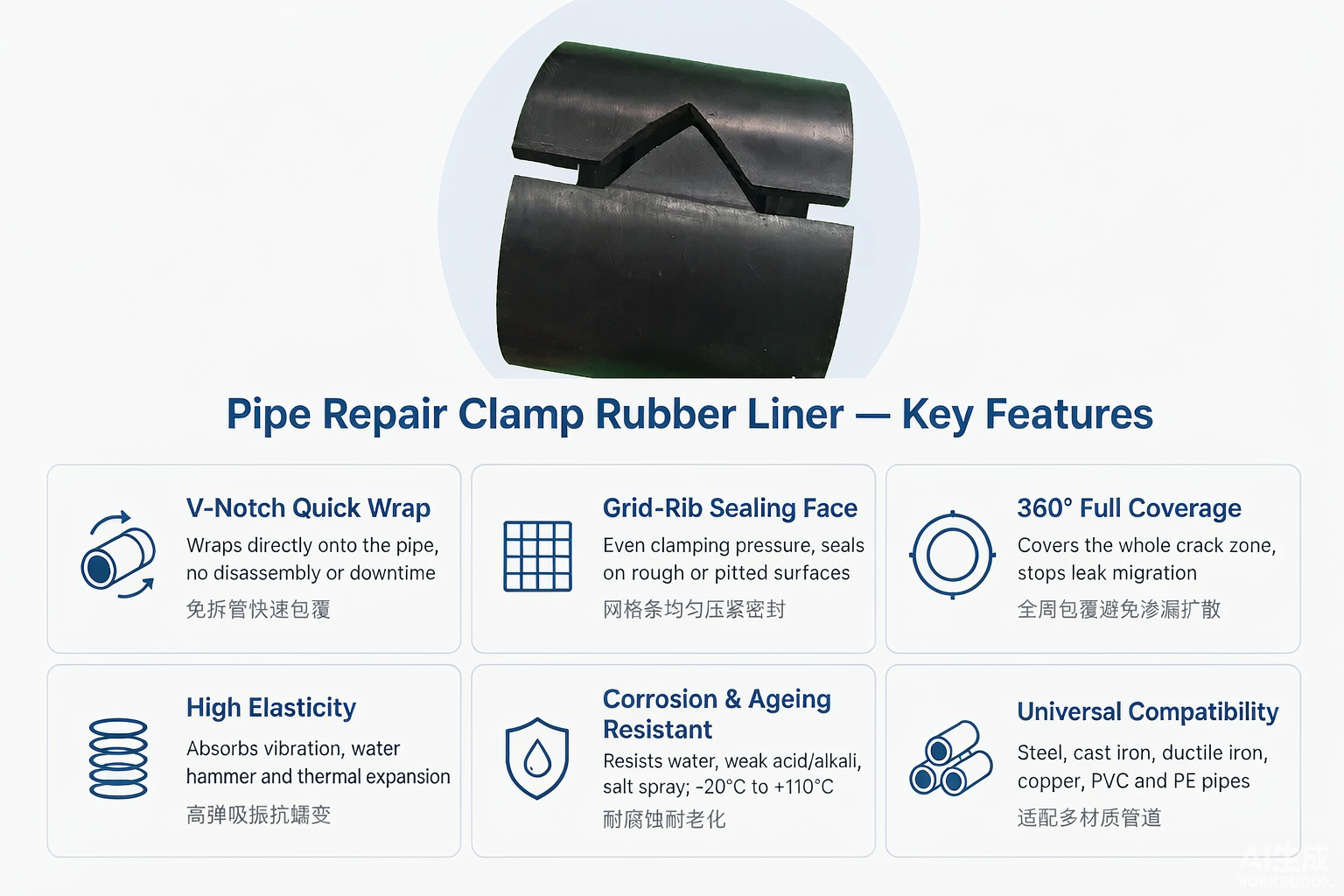
V-Shaped Special Liner: Designed for a Tighter Seal
The V-shaped liner features a raised V-profile on the inner surface that follows and presses into the pipe surface. For repair clamps, this geometry delivers four clear advantages:
Stronger sealing performance — The V-shaped structure fits the pipe surface closely, concentrating pressure on the leak area and reducing re-leakage risk.
Better pressure resistance — The profile prevents the liner from shifting or extruding out of position, even under high internal pressure.
Longer service life — Less wear and deformation over time means the repaired section stays sealed longer, with fewer callback repairs.
Suitable for harsh conditions — Performs reliably in high-pressure, high-vibration, and large-diameter pipeline repairs where flat liners often fall short.
For repair work on municipal mains, pump discharge lines, and industrial pipelines, the V-shaped liner is the better choice wherever sealing reliability and long-term performance matter.
Normal Flat Liner: Simple, But Limited
The flat liner is the most common design in low-cost repair clamps. It is easy to manufacture, but its performance limits are equally clear:
Relatively weaker sealing — The flat surface has less contact pressure on the pipe, making it more prone to slow weeping.
Lower pressure resistance — Under high pressure, the liner may shift or deform, weakening the seal.
Shorter service life — More wear and deformation over time, especially at the repair point.
Less suitable for harsh conditions — Not recommended for high-pressure, high-vibration, or large-diameter repairs.
Flat liners are acceptable for temporary or low-pressure repairs — but for permanent repairs on critical infrastructure, they are rarely the right choice.
What Buyers Should Check Before Ordering
Two repair clamps can look almost identical from the outside yet perform very differently once installed. When sourcing repair clamps, always confirm:
The liner structure — V-shaped or flat;
The rubber compound (EPDM / NBR) matched to the media and temperature;
Whether the liner stays in position under the clamp’s rated pressure.
Better Liner, Better Sealing, Longer Service Life
Source Repair Clamps with V-Shaped Liners from Changhong Flex
Changhong Flex supplies pipe repair clamps, wide-range flexible rubber joints, metal expansion joints, water meters, and related pipeline accessories for B2B export. Our repair products are available with V-shaped special liners for demanding applications. With 10+ years of factory experience, ISO 9001 / CE / SGS certifications, small MOQ, and customization from drawings, we help contractors, distributors, and traders deliver repairs that hold.
Contact us today for specifications, samples, or a quotation.